
Galaxy Research is trying to explain one of the stranger Bitcoin transactions of the year after five addresses sent roughly 107 BTC, worth about $8.3 million, to an old burn address, making the coins provably unspendable. The move, flagged by Galaxy in a thread on X, immediately raised the question that sits at the center of the episode: why would anyone deliberately destroy a large amount of Bitcoin rather than sell it, move it, donate it, or leave it dormant?
“ACTUAL ONCHAIN BOATING ACCIDENT?” Galaxy Research wrote. “On Monday, 5 bitcoin addresses sent ~107 BTC ($8.3m) to an old burn address, making the coins provably unspendable. Why would someone do this? The Galaxy Research team’s best theories are in the thread below (spoiler: none are very good).”
The burn address in question is not merely a wallet whose owner lost a key. Galaxy said the address, 1111111111111111111114oLvT2, corresponds to a Hash160 value of twenty zero bytes. Encoding that with Bitcoin’s P2PKH version byte produces the address. In practical terms, spending coins from it would require finding a public key whose Hash160 is all zeros, an outcome Galaxy framed as computationally out of reach.
That makes the transaction different from a mistaken transfer to an exchange address, a wallet controlled by an unknown counterparty, or an address whose private key may exist somewhere. The coins were not simply moved into obscurity. They were sent to a destination designed to be unspendable.
Theories Why Someone Burns $8.3 Million In Bitcoin
Galaxy’s first theory was tax-related, but the firm appeared skeptical of its own explanation. A sender could have been attempting to create a tax loss by destroying the coins, the team wrote, but that logic weakens if the Bitcoin was acquired long ago. “Most are very old, so selling them would produce gains, not losses,” Galaxy said.
The thread then moved into more speculative territory. Galaxy suggested the burn could have been motivated by religious reasons, citing traditions in which adherents renounce possessions. But it also noted that giving assets away, rather than destroying them, is the more typical pattern. That distinction matters: a donation or transfer would move wealth to another party, while a burn removes it from circulation entirely.
Another possibility raised by Galaxy was that the coins were tied to illicit activity and that the sender concluded there was no viable path to launder or spend them. In that scenario, destruction would function less as a financial decision than as a risk-management act, eliminating the asset rather than attempting to move it through traceable channels.
Galaxy also floated darker explanations involving coercion. “Perhaps the sender was under some form of duress, such as torture or threat of kidnapping or bodily harm, and instead of making him spend the coins to the attacker, the attacker is sick and twisted and instead demanded the victim destroy his wealth. We sincerely hope it is not this one.” The firm added a related theory in which proof-of-burn was demanded as an initiation ritual for a club or cult.
The most striking theory, and the one Galaxy described as “perhaps among the most likely,” was not human ideology or criminal pressure but an automated error. The team imagined a large trading or Bitcoin operation using an agentic system to execute transfers. “Say you are running a big agentic trading or bitcoin operation, and you recently onboarded a new counterparty,” Galaxy wrote. “You instruct your agent to ‘send the counterparty 107 BTC’ and the [agent] accidentally sends it to the Countparty (Burn Address) instead of your counterparty.”
The typo-like logic behind that theory is notable. “Counterparty” is also associated with one of Bitcoin’s older burn mechanisms, and the address used here has long been known as a burn destination. If an automated system confused a real counterparty with a burn address label, the result could be catastrophic: an irreversible transfer with no recovery path.
Galaxy did not claim to have identified the sender, and the thread made clear that each theory remains conjecture. “We may never know who sent the 107 BTC or why, but these are the best we can come up with,” the firm wrote, inviting other explanations.
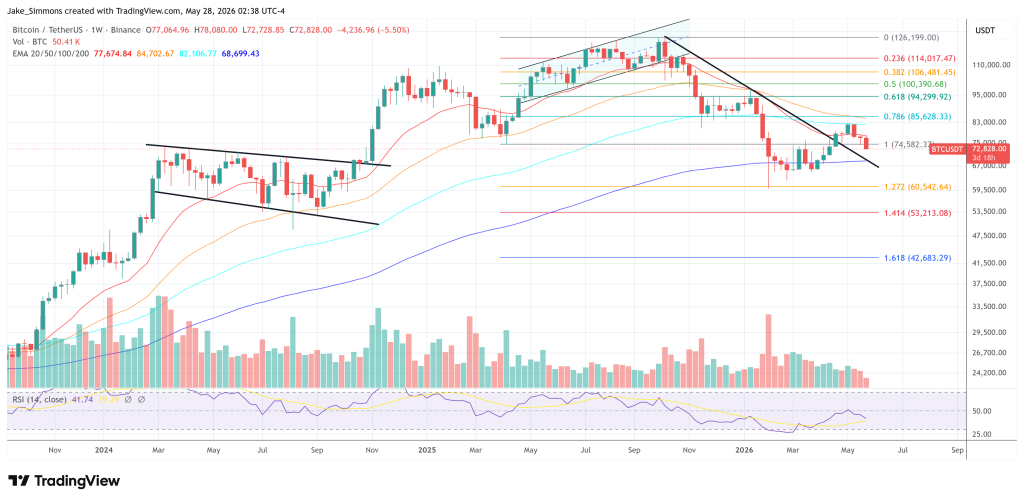
At press time, BTC traded at $72,828.

You can get bonuses upto $100 FREE BONUS when you:
💰 Install these recommended apps:
💲 SocialGood - 100% Crypto Back on Everyday Shopping
💲 xPortal - The DeFi For The Next Billion
💲 CryptoTab Browser - Lightweight, fast, and ready to mine!
💰 Register on these recommended exchanges:
🟡 Binance🟡 Bitfinex🟡 Bitmart🟡 Bittrex🟡 Bitget
🟡 CoinEx🟡 Crypto.com🟡 Gate.io🟡 Huobi🟡 Kucoin.















Comments